on this page (8)
book lovers abhor a vacuum; since there’s no host for this month’s book club six days in, I decided to host. for October’s IndieWeb Book Club, I chose A Psalm for the Wild-Built by Becky Chambers. as a novella clocking in at 160 pages, it’s a short read to make up for the days lost. I wanted something short enough that joining in halfway through the month wouldn’t feel like signing up for homework, but with enough substance to send our thoughts in different directions.
the first in Chambers’ Monk and Robot duology (next in the series is A Prayer for the Crown-Shy), it won the 2022 Hugo Award for Best Novella and offers an accessible introduction to the solarpunk and hopepunk genres.
as my own fiction choices generally tend to involve heavier, more dystopian-skewing material (currently reading Philip K. Dick’s A Scanner Darkly, which, like the movie, is not feel-good!), I opted for a book choice that might leave us feeling better about humanity and the state of the world after the final page 🤓
Wikipedia synopsis
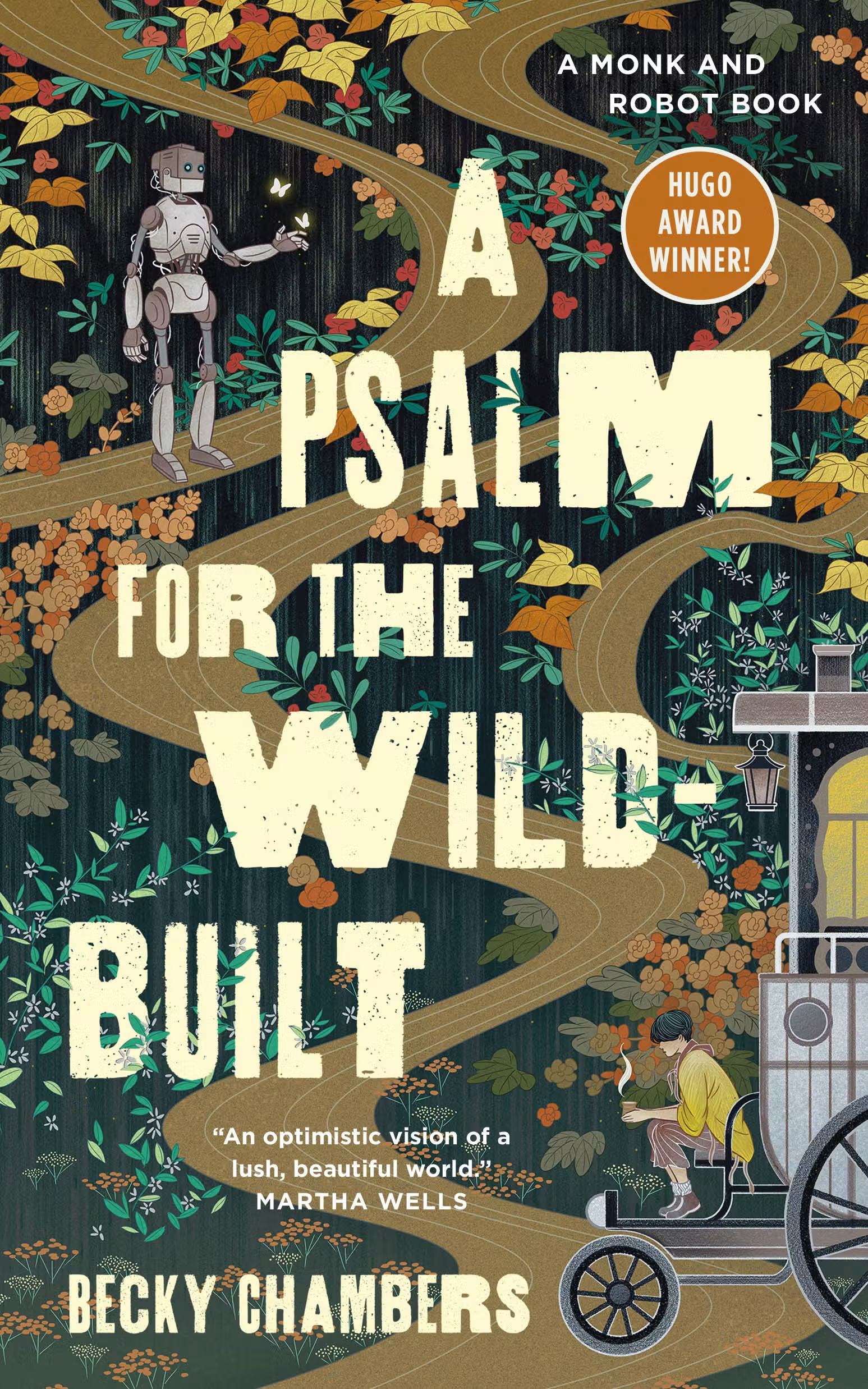
On a habitable moon called Panga, AI and robots used to have a central role in the urbanized, industrialized society. However, several hundred years ago, the robots left human society and disappeared to the wilderness. Without their AI and robot workers and high-tech automated factories, the humans switch to a sustainable solarpunk lifestyle, with farms and small communities.
Dex, a non-binary tea-serving monk, is traveling around the human-populated areas of their moon, going from one community to another. Dex’s goal is to meet villagers and townsfolk and custom-blend tea to fit the people’s needs and personalities. In addition to being an act of service, Dex also uses tea serving as an “ice-breaker” to enable people to confide their misgivings and concerns to them.
One day, Dex, seeking a change in their routine, travels far beyond the agrarian communities into the unsettled wilderness. They are shocked to encounter a robot, as humans have not seen robots for centuries, ever since the robots left for the wild. The robot, named Splendid Speckled Mosscap, joins Dex on a road trip deeper into the wilderness to find an abandoned monastery. Dex and Mosscap are both searching to find “What do people need?”
want to join me? read A Psalm for the Wild-Built sometime this October and post on your own blog a full review, a favourite passage, a question it leaves you with, or a few sentences about how you found it. send me your post via email or Webmention by 31 October 2026 (or a note that you’ve a late submission incoming); I’ll add links to all entries here as they come in. I’d love to hear what you make of it, whether or not it’s your cup of tea 🍵🤖
book club
folks who read
-
Literary hugs: Do you have milk and optimism with your tea?
by V.H. Belvadi
highlights the book’s rare, gentle optimism and its comforting message about purpose, calling it a “literary hug” for anyone feeling weary of the world 📖🤗
read V.H.’s full review →
This book will not beat you into submission in the name of reality and naïvety, allowing you instead to roam a world where you are allowed to believe in the inherent goodness of things and feel a sense of vindication for it. We can all do with more of that.
-
“A Psalm for the Wild-Built” by Becky Chambers
by Travis Bryant
appreciates the book’s unhurried pace and rich world-building, lingering on why safety and comfort don’t necessarily bring contentment—and finishing with a craving for more tea 🍵🫖
read Travis’s full review →
I don’t know if there is officially a cozy solarpunk speculative cli-fi category, but this would certainly be the best read to have on that shelf.
-
A Psalm for the Wild-Built: a review (of sorts)
by Nadja Bester
finds a world to rest in and an invitation to loosen purpose’s grip, following the book’s hopeful possibilities into being, belonging, and boiling the kettle for each other 🍵🌱
read my full review →
these books reminded me that the gilded cage of purpose also has a key you can use to free yourself. being is mandatory. purpose is optional. and being—so the little sage-who-knows-things growing inside me whispers—sells the best flavours of purpose inside its storehouses.
review roundup
a big thank you to V.H. Belvadi and Travis Bryant for participating. reflecting on the selection choice a month later, I’m glad to have chosen it. not only does it seem to have been an all-round positive reading experience, but across participant reviews, we came away with more hope, some room to rest, and permission to exist without having to justify it. good stuff!
V.H., in his review captures the light and warmth the book offers against the world’s darkness. about the strength to face another day. he highlights the feeling the story creates that goes beyond its characters, places, and plot. as a literary hug, he says, its cosiness provides emotional reassurance, with apparently ordinary conversation becoming a deeply meaningful discussion. that sense of peace, in turn, makes room for introspection.
Travis’ review views the book as a balm amid our contemporary craziness. he emphasises the peaceful pacing that allows one to float through the story, offering an unhurried reading experience that feels peaceful and intentional. big questions, he notes, can be found in a slim book without the need for battles or explosions. the story provides a slow pilgrimage built around questions rather than action, featuring heart-warming characters and an overall harmony with nature.
my review found it to be a world I could rest in, a comforting read through which to think about purpose, technology, and community care inside a society of kind humans organised around well-being rather than exploitation. the book, I note, allows one to examine technology without equating simplicity with backwardness; its resource use and way of life may differ from ours, yet it doesn’t leave you imagining the characters in that world as deprived.
across the board, we all discovered that the sense of comfort the book provides didn’t close down thought, but instead made (sanctuaried) room for it. the reading experience itself is a gentle one, yet it leaves you spending considerable time with unresolved questions in a way that’s both uplifting and intellectually substantive.
if you were planning on participating but time caught up with you somewhere in between, feel free to send your post my way whenever it’s ready! and if you’re on the fence about reading A Psalm for the Wild-Built, consider this a highly positive “just do it!” from a chorus of satisfied readers 🎼