nadja bester.
stream menu
stream permalinkNadja Bester

stream

small updates, observations and links. because social media is so last season.

photos → · all tags →

why static site generators

why static site generators? PHP2Shell is why

there are already 74 billion reasons and counting to break up with (or stay away from) WordPress (which around 40% of all websites run on), but you can officially add PHP2Shell to the list. PHP enables nearly 70% of all…

read full post →

there are already 74 billion reasons and counting to break up with (or stay away from) WordPress (which around 40% of all websites run on), but you can officially add PHP2Shell to the list.

PHP enables nearly 70% of all websites on the internet with an identifiable server-side programming language. WordPress relies on it, but PHP's massive footprint extends also to other giants (think Drupal + Joomla + Magento + Laravel, etc)

22 years ago in 2004, security pioneer Stefan Esser identified a critical PHP memory-limit vulnerability. now, two newly disclosed vulnerabilities show how dangerous PHP’s memory-handling flaws remain. these affect unpatched PHP releases dating back to 5.4 (released March 2012), including the current 8.5 series (released Nov 2025): an unauthenticated attacker can execute code remotely on a vulnerable PHP server, potentially taking over the site 😱 (Nick Rogers does a detailed, albeit highly technical, roundup of the issue.)

portfolio sites, blogs, and business websites that don't require user login systems, complex shopping carts, real-time databases, or personalised user dashboards can avoid this whole category of PHP risk by using a static site generator (SSG). a purely static deployment needs no live application database / server-side page generation. so, with no PHP handling web requests, a vulnerability like PHP2Shell has nothing to hijack.

want a sense of how serious this is? Even Japanese PM Sanae Takaichi tweeted out urging PHP website owners to apply the patch ASAP or take their websites down temporarily if they couldn't. (governments around the world have been doing just that; even parts of Wikimedia went offline while they patched up!)

photos

Dacrymyces spathularia striking a pose

also known as the fan-shaped, this gorgeous lil' thing that grows on rotting wood can help keep drinks from spoiling 🤯 a master at decomposing wood (as a brown-rot fungus, it breaks down the cellulose and hemicellulose…

read full post →

Dacrymyces spathularia striking a pose

also known as the fan-shaped, this gorgeous lil' thing that grows on rotting wood can help keep drinks from spoiling 🤯

a master at decomposing wood (as a brown-rot fungus, it breaks down the cellulose and hemicellulose in rotting wood), Dacryopinax spathularia is also cultivated commercially to produce natural antimicrobial compounds (long-chain glycolipids) used as a preservative in beverages (eg Nagardo®).

its yellow-orange pigmentation comes from carotenoids that protects it against ultraviolet radiation, and it's actually an edible species! known in Chinese cuisine as sweet osmanthus ear, including Buddha's delight.

early lab + animal studies indicate interesting medicinal potential: acetylcholinesterase inhibition (the same enzyme targeted by the Alzheimer's medication donepezil), antioxidant activity, inhibition of enzymes associated with inflammation and starch digestion, and improvements in liver injury markers (ALT, AST, ALP, and bilirubin) in rats.

no demonstrated medicinal benefits in humans just yet, but what a biochemical resume for this beautiful little orange fungus! 🍄

photos

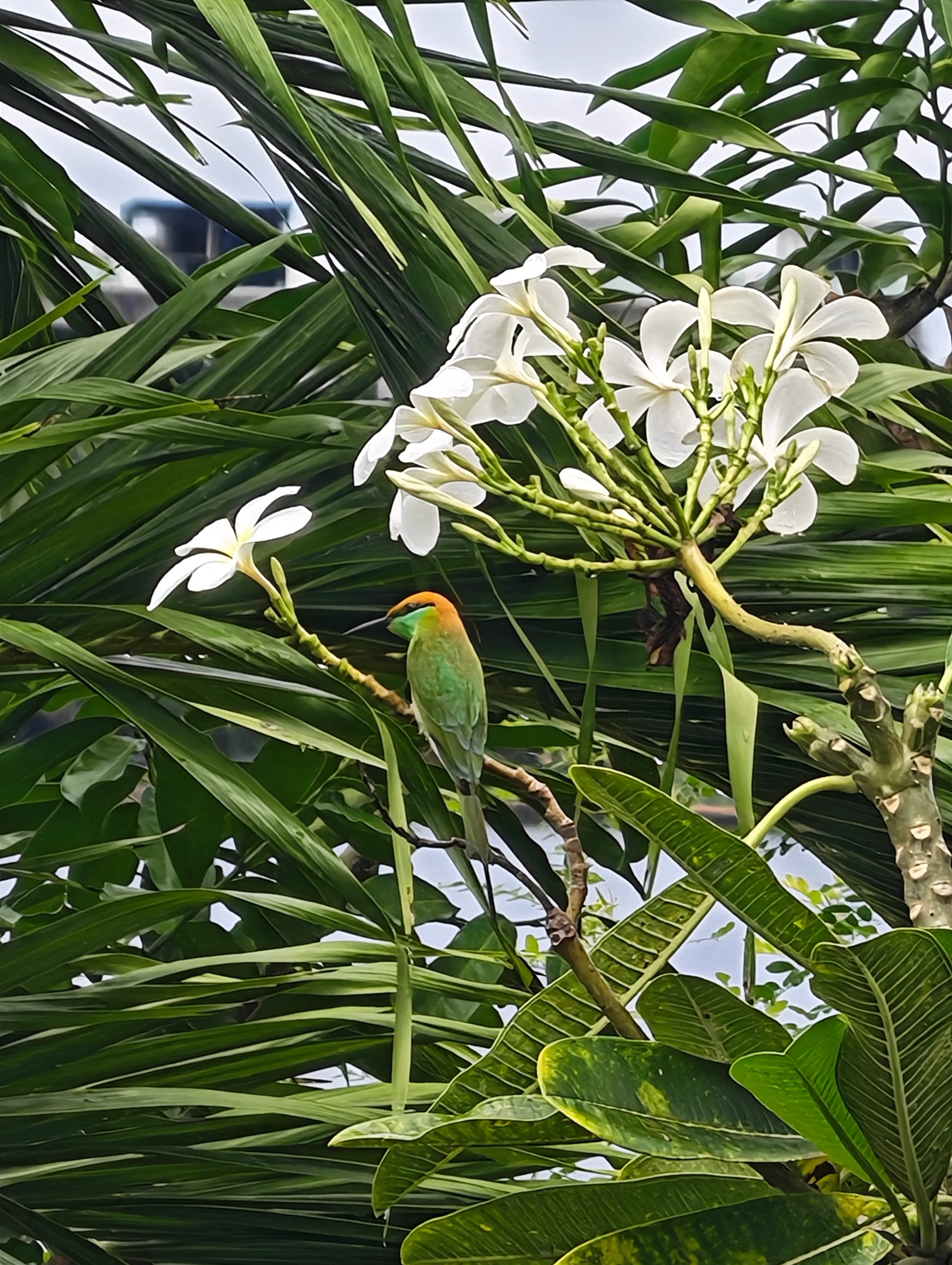
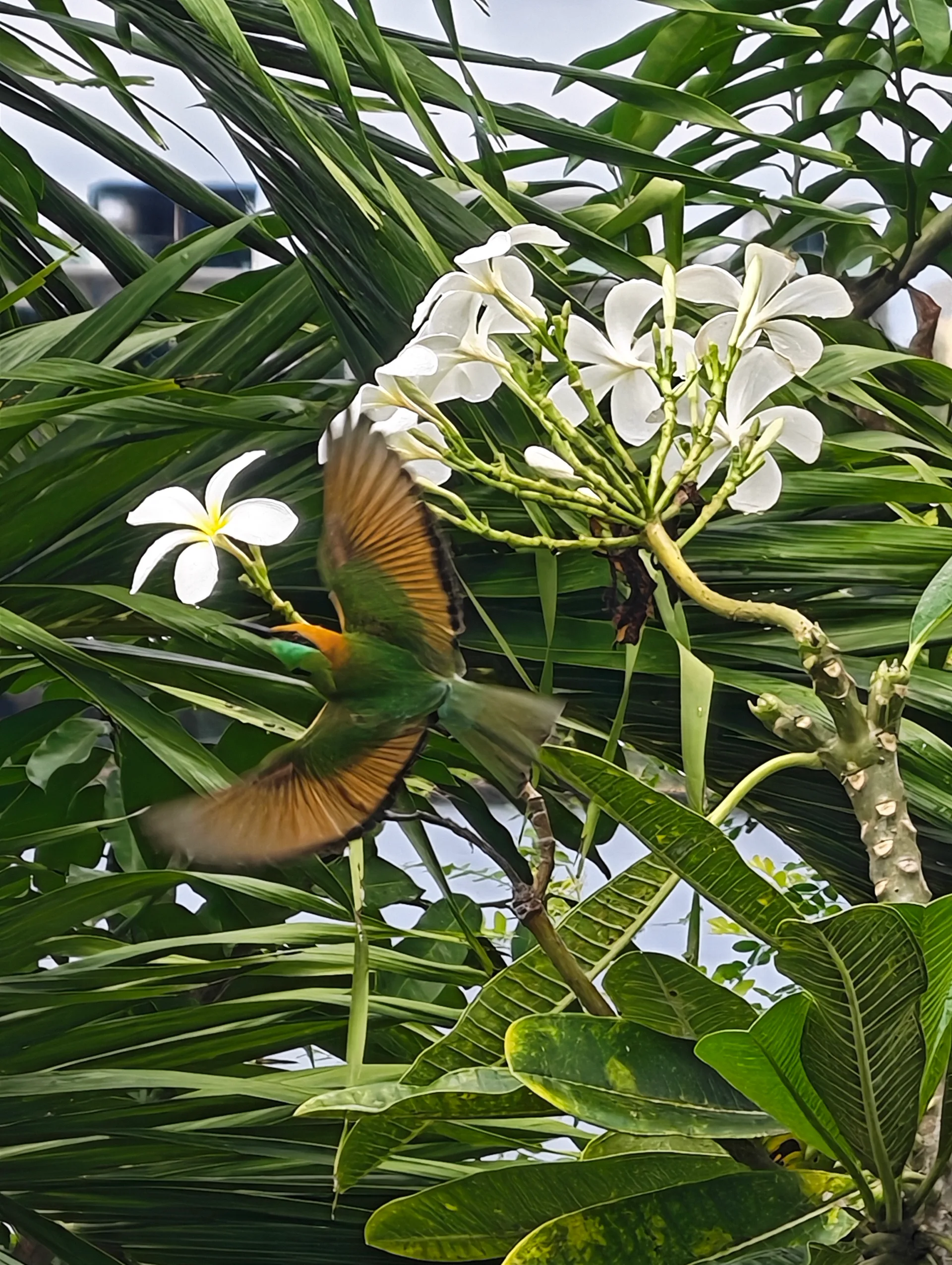
flight of the bee-eater 🦜

Merops orientalis (Asian green bee-eater) in our frangipani tree 🦜 found everywhere from coastal Iran to the Indian subcontinent and as far east as Viet Nam; in the Himalayas, they can be found as high up as 2,000m! fun…

read full post →

Asian green bee-eater in flight

Asian green bee-eater in frangipani

Merops orientalis (Asian green bee-eater) in our frangipani tree 🦜

found everywhere from coastal Iran to the Indian subcontinent and as far east as Viet Nam; in the Himalayas, they can be found as high up as 2,000m!

fun fact: members of the bee-eater family (31 species' worth) nest in tunnelled burrows in sandy banks ⛱️

books & reading

utopia forgets why people like the mess

"…what is so wonderful about being big? It is often said that the world is suffering from the ills of bigness, and we now have some clinical examples in our large cities. Many cities are probably past the point of good…

read full post →

"…what is so wonderful about being big? It is often said that the world is suffering from the ills of bigness, and we now have some clinical examples in our large cities. Many cities are probably past the point of good government because too many things are wrong. Should we not rather ask whether we need cities? With modern systems of communication and transportation, businesses do not need to be within walking or taxicab distances of each other, and how many people must one be near in order to live a happy life? People who flock to cities looking for jobs and more interesting lives will flock back again if jobs and more interesting lives are to be found where they came from. It has been suggested that, with modern systems of communication, the America of the future may be simply a network of small towns."

—B.F. Skinner, Walden Two Revisited (1976)

starting Skinner’s Walden Two (1948). by this 1976 preface, he was already predicting comms would dismantle mega-cities into a network of small towns. (he sure did get remote-work logistics right decades early 😅)

since his work is known for out-engineering friction + trading human messiness for predictability, I'm curious to see if his behavioural utopia misunderstood why people still crave the chaos of the city, as I sometimes do/often don't 🤹‍♀️

technology & society

AI is a motorcycle for the mind

Eric C. So in his recently released book, The Collision: What AI Does to Us, uses a great analogy to describe AI. So, a Professor of Global Economics and Behavioral Science at MIT’s Sloan School of Management, draws from…

read full post →

Eric C. So in his recently released book, The Collision: What AI Does to Us, uses a great analogy to describe AI.

So, a Professor of Global Economics and Behavioral Science at MIT’s Sloan School of Management, draws from Steve Jobs' 1980 analogy that technology is "a bicycle for the mind" (itself based on Stuart S. Wilson's 1973 Scientific American study, Bicycle Technology—a fascinating read!—on the energy efficiency of movement between different species and machines that put the salmon in first place, topped only by a human on a bicycle).

play YouTube video

AI, So argues, is a motorcycle for the mind, stating, "…motorcycles come with warnings that bicycles don’t. When power increases, so does risk. They’re harder to hold steady and require more skill to operate safely. You wouldn’t hand one to a child without serious training. When things go wrong on a motorcycle, they go wrong at speeds that multiply the consequences."

AI, he reminds us, comes with important caveats:

"An amplifier of human intention, one so powerful that it qualitatively changes the relationship between human and machine. A tool that can take you places you couldn’t reach before. But one that can also take you off a cliff if you don’t know what you’re doing. Like a motorcycle, AI isn’t inherently good or bad. It depends entirely on how you use it."

why IndieWeb

why IndieWeb? WordPress plugin Rank Math PRO is why

copies of popular WordPress plugin, Rank Math SEO PRO v3.0.123, downloaded between Oct 15 (20:02 UTC) + Oct 16 (07:12 UTC), 2026, shipped with active malware that created backdoors connecting to rank1cdn[.]com (via…

read full post →

copies of popular WordPress plugin, Rank Math SEO PRO v3.0.123, downloaded between Oct 15 (20:02 UTC) + Oct 16 (07:12 UTC), 2026, shipped with active malware that created backdoors connecting to rank1cdn[.]com (via Wordfence)

⚠️ deactivating/updating alone won't clean the Trojan injection ⚠️

handing total site execution privileges to opaque, multi-megabyte plugin suites just to output <head> tags is a massive supply-chain risk ☠️

full-blown SEO suites install persistent background processes + scheduled cron tasks + external API hooks + custom auto-updaters… all for basic markup you can write directly in your theme

👎 fragile, proprietary mega-plugins controlling your site

👍 lightweight, auditable templates for Microformats (h-entry, h-card), OpenGraph, and JSON-LD

outputting basic HTML meta tags should NOT be compromising your entire website!

photos

mushroom matar 🤤

ngl, been fantasising about this ever since (I didn't even mention it in) James' Food Questions challenge. so today I had me some north Indian curry with button mushrooms, green peas, onion-and-tomato masala, and…

read full post →

mushroom matar curry

ngl, been fantasising about this ever since (I didn't even mention it in) James' Food Questions challenge.

so today I had me some north Indian curry with button mushrooms, green peas, onion-and-tomato masala, and fenugreek 🇮🇳👌

wonder what my taste buds will compel me to revisit next on my foodie list… 🍴

mind & meaning

does the camera capture who you are, or who the photographer thinks you are?

how does a photographer's personal perspectives and preconceptions influence their presentation of their subject? I hate having my photo taken, yet seeing myself through my partner's lens almost always makes me feel like…

read full post →

how does a photographer's personal perspectives and preconceptions influence their presentation of their subject?

I hate having my photo taken, yet seeing myself through my partner's lens almost always makes me feel like a work of art. witchcraft? or another example of applied quantum physics in the form of the observer effect?

Canon did a fascinating experiment that drives this point home. THE LAB: DECOY tasked six different photographers with different (fabricated) back stories on the same man and given ten mins to capture the "essence" of their subject.

ranging from self-made millionaire, ex-convict, commercial fisherman, psychic, recovering alcoholic, and a lifesaver, each portrait then goes on to eerily capture the proposed identity as if that narrative were indeed the case. great demonstration of a self-fulfilling prophecy, aka the Pygmalion effect!

play YouTube video
mind & meaning

why bad news only ruins the next 5 years of your life

one of the many fascinating cognitive gymnastics about humans is our ability to see the collective future (macro issues like economic decline, war, climate crisis, etc.) as disastrous while simultaneously excluding…

read full post →

one of the many fascinating cognitive gymnastics about humans is our ability to see the collective future (macro issues like economic decline, war, climate crisis, etc.) as disastrous while simultaneously excluding expectations of our own individual futures from that projected reality.

this mental time travel differentiates between personal future thinking and a related optimism bias, and collective future thinking (chronic pessimism bias).

interesting new research paper in the Applied Cognitive Psychology journal studied the breakdown of this psychological firewall and how temporal distance acts as a psychological buffer against collective pessimism:

  • near-term vulnerability (0–5 years):

    • reality check works; we lose our rose-coloured glasses once we realise global problems will spill into our everyday lives, impacting our optimism for the future.
  • distant-future insulation (10–15 years):

    • optimism bounces back; we imagine our far-off lives will be fine and feel little emotional distress about it (it does, though, dial it down a notch from "amazing" to "good"); our brain turns it into a movie of sorts, able to suspend disbelief long enough to imagine grim consequences for others while believing ourselves shielded from it.

paper: Exposure to Negative Information About the Collective Future Eliminates the Positivity Bias for the Personal Events in the Near Future by Şule Gülpınar Çiftkaya, Esra Konan Ay, and Simay Ikier.